


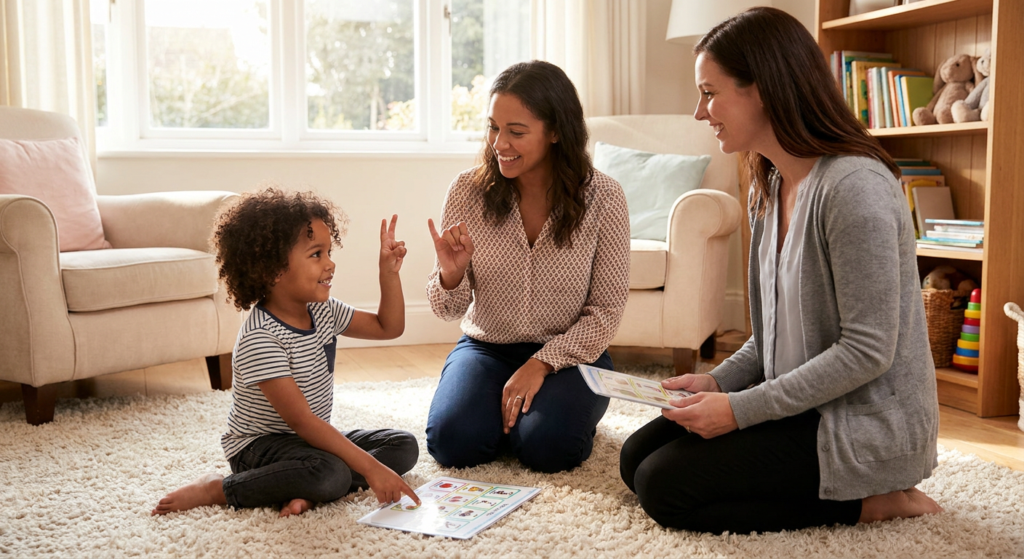
If you are searching for autism non-verbal communication, you may be trying to answer two questions at the same time: how your child is communicating right now, and what could help them communicate more clearly. That can feel exhausting when your child is non-speaking or minimally speaking and daily routines seem full of guesswork. The good news is that communication is often already happening through gestures, body movement, facial expressions, pictures, routines, vocalizations, and behavior. AAC and signs can build on those early signals so your child has more reliable ways to connect, ask for help, make choices, and participate in daily life.
What Non-Verbal Communication Means in Autism
Non-verbal communication in autism refers to the many ways a child may express meaning without relying on spoken words alone. That can include gestures, eye gaze, facial expressions, body movement, pointing, pictures, signs, and AAC, which stands for augmentative and alternative communication.
That is different from nonspeaking or minimally speaking autism. A child may have limited spoken language and still communicate a great deal non-verbally. Parents often land on this topic because they are trying to answer two urgent questions: “What is my child already telling me?” and “What support could help my child communicate more clearly?”
Communication may look different depending on age and stage. Toddlers may reach for a snack, lead an adult by the hand, shift eye gaze between a toy and a parent, or protest when a routine changes. School-age children may point, pull up a picture, use a few signs, or press a button on a device during familiar routines. Teens may use mixed communication methods, with needs that are more tied to independence, privacy, and context.
It helps to remember that spoken language is not the only sign of communication progress. A child who can reject, request, choose, or get help more clearly is making meaningful progress, even if speech is still limited.
How Communication May Already Be Happening in Daily Life
Before a new tool is introduced, many children with autism are already communicating in ways that matter. A child may push a plate away at mealtime, bring a favorite item to an adult during play, stiffen during dressing, or pace near the door before a transition. Eye gaze, facial tension, body position, vocal sounds, and protest behavior can all carry information about needs, preferences, discomfort, or overwhelm.
That does not mean every behavior should be treated as a deliberate message. It does mean behavior can give useful clues, especially when the same pattern shows up in similar situations. A younger child may rely on very immediate signals such as reaching, crying, pulling, or dropping to the floor when communication breaks down. An older child may need support to communicate across more settings and with more people, especially during school-home handoffs, community outings, or less predictable routines.
Parents should not feel pressure to decode every signal alone. This is where collaboration matters. Speech-language pathologists, BCBAs, occupational therapists, teachers, and caregivers can help identify patterns, reduce guesswork, and build support plans that are practical across the full day.
If you are also trying to understand whether communication support is carrying over beyond the classroom, our guide on how to tell if your child needs in-home ABA therapy explains how to think about support across school, home, and daily routines.
The SIGNAL Fit Framework
The SIGNAL Fit Framework gives parents a practical way to notice what is already working, where communication breaks down, and what type of support may fit best.
S — See the message already happening
Start by noticing what your child is already doing to communicate. Look for gestures, reaching, eye gaze, body movement, vocalizations, pictures, routines, and protest behavior. When those attempts are noticed and responded to, you build from something real instead of replacing it with a system that feels disconnected from daily life.
I — Identify the breakdown moments
Next, map the moments where communication fails most often. For younger children, that may be snack choices, asking for help, stopping a preferred activity, or handling transitions. For older children, breakdowns may show up around independence, social participation, flexible choices, waiting, or coping under stress. Recurring patterns matter more than one isolated hard moment.
G — Gauge the best communication match
Then look at fit. A support should match your child’s motor abilities, imitation skills, visual strengths, attention, regulation, and everyday environments. Signs may be useful for one child, while picture exchange, low-tech boards, or a speech-generating device may be more practical for another. In many cases, the best answer is not one perfect tool, but a multimodal plan.
N — Name the support team and carryover plan
Communication works better when the same approach is used across home, school, and therapy. Identify which adults need to model the system, prompt it, and respond to it consistently. When each setting uses a different method, children can end up relearning communication from scratch throughout the day.
AL — Anchor progress in daily life
Measure progress by functional wins. Is your child making clearer choices? Asking for help with less frustration? Moving through transitions more smoothly? Communicating “no” more safely and effectively? These daily improvements matter, even when spoken language is still developing.
Comparing AAC, Signs, and Other Communication Supports
AAC includes both low-tech and high-tech tools. The American Speech-Language-Hearing Association’s overview of AAC notes that AAC can include gestures, pictures, communication boards, and speech-generating devices, not just one type of system.
Here is how common communication supports differ:
- Gestures and body signals: Helpful when a child already points, reaches, pulls, or uses body movement consistently. They are fast and portable, but they can be hard for unfamiliar communication partners to interpret.
- Basic signs: Useful for children who can imitate hand movements and benefit from immediate, concrete communication. Signs can work well at home and in familiar routines, but they require communication partners who understand them and may be harder if motor planning is a concern.
- PECS or picture exchange: Often helpful for teaching clear requesting and early initiation. It provides a visible, concrete option, though setup and consistency matter.
- Low-tech choice boards or visuals: Useful for making choices, showing first-then routines, supporting transitions, and reducing language load. They are flexible and easy to use across settings, but they still need modeling and repetition.
- Speech-generating devices or high-tech AAC: Helpful when a child needs a broader range of messages, more independence, or communication that unfamiliar partners can understand more easily. Devices can support growth over time, though they require teaching, access, and carryover.
- Multimodal communication: Many children do best when they can combine gestures, visuals, signs, vocalizations, and AAC. This often reflects how communication works in real life rather than forcing one method to do everything.
Younger children may do best with highly concrete options that work in the moment. School-age children often benefit from more flexible combinations. Teens may need supports that are fast, socially practical, and respectful of dignity and independence.
A common fear is that AAC or sign language means giving up on speech. That is not how communication support should be framed. The goal is to increase access, reduce frustration, and make participation possible now. The National Institute on Deafness and Other Communication Disorders emphasizes that children with autism may have a wide range of communication needs, which is why support should be individualized rather than delayed until speech outcomes are certain.
Helping Communication Work Across Home, School, and Daily Routines
A communication support is most useful when it shows up in real life, not just during therapy. If a child is learning to request with pictures, that support should appear during snacks, play, dressing, transitions, and outings, not only in a structured session. If a child is using a device to ask for help, adults need to pause, model the message, and respond to it in natural moments.
Families can help by keeping communication opportunities functional and frequent. Offer real choices at mealtime. Use visuals before transitions. Practice asking for help during play. Bring the same supports into community routines where waiting and flexibility are harder. Coordinate with school and therapy teams so the child is not expected to use one system in one place and a different one somewhere else.
Younger children may need more repetition and simpler routines. Older children may need support for self-advocacy, more specific preferences, and communication across different environments and partners. In either case, signs that a method is helping include clearer requests, less frustration, smoother transitions, more independent choice-making, and fewer communication breakdowns.
Which Communication Support Fits This Moment? (Tool / Checklist Section)
Use this checklist before or after an evaluation, school meeting, or AAC conversation to organize your observations and next-step questions.
Requesting wants and needs
- Best options to consider: gestures, signs, PECS, choice boards, device buttons
- Good first trial: offer two clear choices during a motivating routine
- Signs the method is working: your child requests more clearly and with less escalation
Asking for help
- Best options to consider: basic signs, help cards, low-tech boards, device phrases
- Good first trial: teach one simple help message during play or a hard task
- Signs the method is working: your child seeks support earlier instead of shutting down or melting down
Making choices
- Best options to consider: pictures, choice boards, device icons, pointing
- Good first trial: use visual choices during meals, dressing, or activities
- Signs the method is working: your child chooses more independently and with less guessing from adults
Rejecting or saying no
- Best options to consider: sign for “no,” picture symbols, device button, gesture plus visual
- Good first trial: teach one clear refusal option during low-stress situations
- Signs the method is working: protest becomes more understandable and safer
Transitions and first-then communication
- Best options to consider: low-tech visuals, first-then boards, simple device phrases
- Good first trial: pair a visual with one common transition each day
- Signs the method is working: transitions become smoother and less surprising
School-home carryover
- Best options to consider: the same visuals, signs, or core messages across settings
- Good first trial: ask the team which messages should stay consistent everywhere
- Signs the method is working: your child uses the same communication more reliably with different adults
Motor imitation demands
- Best options to consider: pictures or device access if fine-motor imitation is hard
- Good first trial: compare how easily your child can copy a sign versus touch or hand over a picture
- Signs the method is working: the system matches what your child can do physically
Visual support needs
- Best options to consider: PECS, boards, schedules, device icons
- Good first trial: add a visual support to one daily routine that already causes stress
- Signs the method is working: your child anticipates routines and communicates with less confusion
Speed and portability in daily routines
- Best options to consider: gestures, a few core signs, portable boards, easy-access device pages
- Good first trial: test what works during short transitions or while out of the house
- Signs the method is working: communication remains possible when life is moving quickly
Consistency across communication partners
- Best options to consider: methods adults can model and respond to the same way
- Good first trial: pick one or two priority messages for everyone to use consistently
- Signs the method is working: fewer mixed signals and faster carryover across routines
FAQ
What is non-verbal communication in autism?
Non-verbal communication in autism includes gestures, eye gaze, facial expressions, body movement, pictures, signs, and AAC. It is broader than speech and different from a child simply being nonspeaking.
How do children with autism communicate without speaking?
Children with autism may communicate through gestures, visuals, vocal sounds, signs, routines, body-based signals, or AAC tools. Communication can look different across children and across settings.
Can non-speaking children with autism learn to communicate with AAC or signs?
Yes, AAC and signs can support clearer communication, more participation, and less frustration. Progress should be measured by real-life communication gains, not only by whether spoken words increase.
Will AAC or sign language stop speech from developing?
AAC and signs are meant to support communication access, not replace human connection or limit development. The right goal is to help a child communicate more effectively now while the team continues to monitor broader communication growth over time.
How can parents support AAC use at home?
Use the method during real routines, honor communication attempts, keep expectations clear, and work closely with your child’s support team. If the system is helping, you may notice clearer requests, more independent choices, and less frustration across the day.
Communication support is not about choosing between speech and connection. It is about giving your child practical ways to be understood. At Skyward Spectrum, that family-centered view matters because meaningful progress often starts when adults learn to recognize the message already happening and build from there.


