


If bedtime has started to feel like the hardest part of the day, you are not the only one. For many families, evenings bring a familiar cycle of stalling, protest, repeated requests, leaving the room, or full overwhelm right when everyone is already tired.
That is what makes this topic so frustrating. “Bedtime battles” can look similar on the surface, but the reason behind them is not always the same. One child may be struggling with a hard transition away from a preferred activity. Another may get stuck on a single step like pajamas or toothbrushing. Another may fall asleep after a tough routine, then keep waking during the night.
This guide is here to help you sort the pattern, make a few practical changes, and decide when it makes sense to get more support. The goal is not to create a perfect routine overnight. It is to make bedtime feel calmer, more predictable, and more manageable for your child and for you.
Why Bedtime Battles Happen for Many Children With Autism
Bedtime can be tough for children with autism for a lot of reasons. By the end of the day, some children are already worn out, dysregulated, or overloaded. Some have a hard time shifting away from preferred activities. Some are reacting to sensory discomfort from clothing, toothpaste, lighting, noise, or the feel of getting into bed. Others have learned, often without anyone meaning to teach it, that asking for one more snack, one more hug, or one more check-in can stretch bedtime out.
That is why it helps to stop thinking of bedtime as one single problem. Sometimes the hard part is getting the routine started. Sometimes the conflict starts at one predictable step. Sometimes lights-out is the real sticking point. Sometimes bedtime itself goes reasonably well, but the bigger issue is night waking or restless sleep.
Age can shape how this shows up. Younger children may cry, run off, drop to the floor, or need more hands-on support moving from step to step. School-age children may bargain, ask repeated questions, call out after lights-out, or leave the room over and over.
It is also worth saying this clearly: not every rough bedtime is about behavior alone. Pain, reflux, constipation, breathing concerns, anxiety, or other sleep-related issues can affect what happens at night. If you want more background on why predictability helps in the first place, this article on why predictable routines matter for children with autism gives a helpful foundation without losing sight of everyday family life.
The REST Map for Bedtime Battles
A simple way to approach bedtime is to use the REST Map for Bedtime Battles. It gives parents a practical way to move from “Why is this happening again?” to “What should we change first?”
R: Read the pattern
Start by noticing where bedtime begins to fall apart. Is the struggle happening before the routine starts? Does one step, like pajamas, toothbrushing, or lights-out, set off the whole evening? Does your child settle at first, then keep calling you back? Or is bedtime manageable while overnight waking is still the bigger concern?
That distinction matters. A child who resists brushing teeth may need a different plan than a child who becomes upset when it is time to separate for sleep. The clearer you are about the pattern, the easier it is to choose a response that actually fits.
E: Ease the friction
Before treating bedtime as refusal, look for what may be making the routine harder than it needs to be. Common friction points include abrupt screen shutoff, a rushed transition, hunger, bathroom needs, uncomfortable clothing, room temperature, lighting, and physical discomfort. High-trust resources like the Stanford sleep toolkit for families of children with autism reinforce the value of looking at environment and body-based needs, not just what happens after a child protests.
Younger children may need more concrete sensory changes and more support settling their bodies. School-age children may benefit from more previewing, more reassurance, and a gentler step-down from busy evening time into bedtime.
S: Script the sequence
Once you have reduced some of the friction, make the routine short, clear, and easy to repeat. Keep the order predictable. Use cues your child can recognize. Choose one or two bedtime behaviors to focus on first, such as starting the routine without a long delay or staying in bed after lights-out. Trying to fix the whole night at once usually makes bedtime feel heavier, not easier.
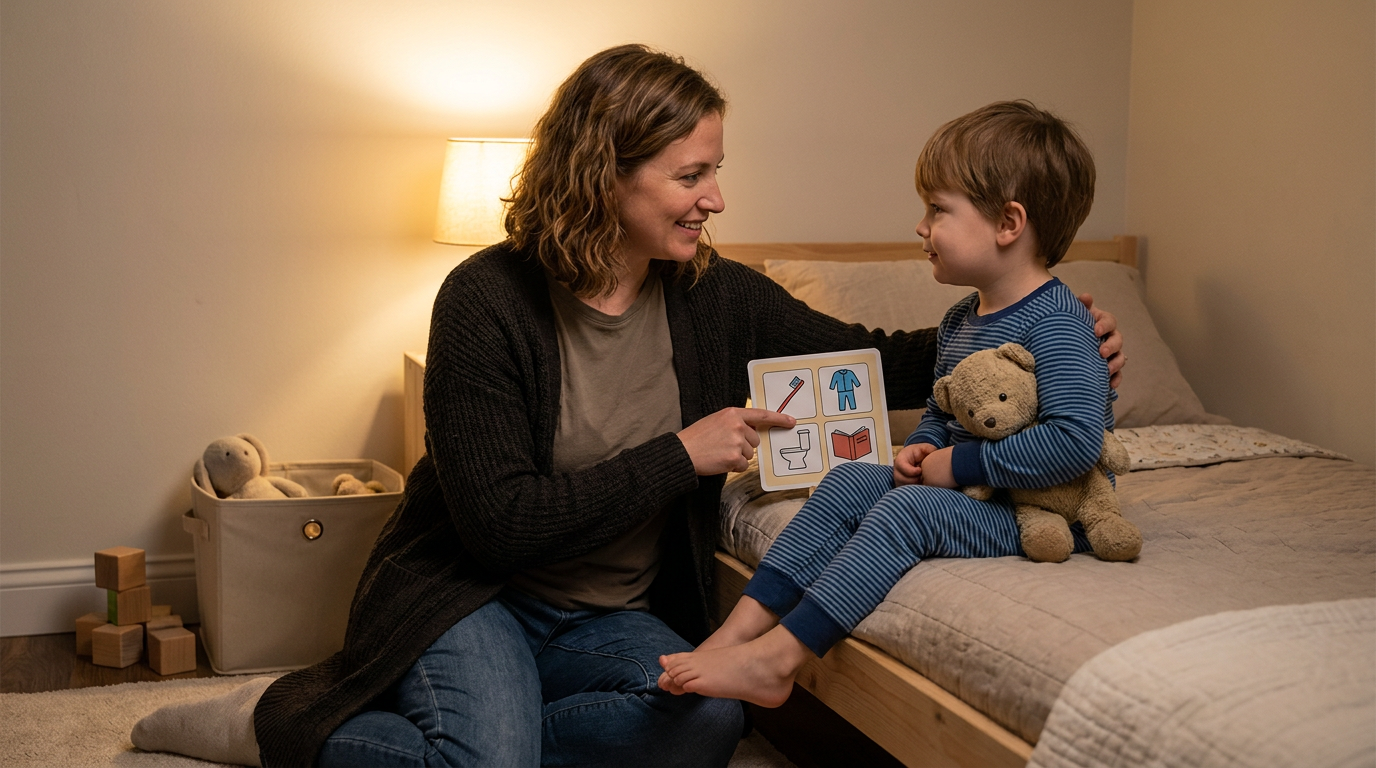
If your child does better when they can see what comes next, visual supports can help. A simple bedtime chart or picture routine may reduce uncertainty and lower stress. If you want examples of how that structure can work in daily life, this guide on using visual schedules to make transitions easier is a useful companion.
T: Track the response
Give the plan a little time, then pay attention to what changes over 7 to 14 nights. Is bedtime starting more smoothly? Is one step still consistently hard? Are adults responding differently on nights when things escalate?
Tracking helps you tell the difference between a plan that needs a small adjustment and a pattern that may point beyond routine alone. A calmer bedtime routine is a real win, but it does not rule out anxiety, a sleep disorder, or a medical concern if your child is still waking often, snoring, or sleeping restlessly.
How to Build a Calmer Bedtime Routine With ABA-Informed Supports
A calmer routine usually starts with making bedtime feel smaller and more predictable. Many families do better with a short sequence of essential steps, such as bathroom, pajamas, toothbrushing, one calming activity, then lights-out. When bedtime keeps changing or includes too many steps, children often end up reacting to the uncertainty as much as the routine itself.
ABA-informed support at home does not have to sound clinical. In everyday terms, it means making expectations clear, teaching the next step, reinforcing the behavior you want to see, and following through consistently enough that your child knows what to expect. For younger children, that may mean modeling each step, using simpler language, and offering more co-regulation. For school-age children, it may mean previewing bedtime, offering limited choices, and being clearer about what independence looks like.
Using ABA strategies without trying to fix everything at once
Pick one or two target behaviors first. Maybe you want bedtime to start with less delay. Maybe toothbrushing has become the hardest part. Maybe your child is getting out of bed repeatedly after lights-out. Start there.
When you see progress, reinforce it right away with calm praise, a simple reward system, or another motivator that genuinely matters to your child. Shaping can be especially helpful here. If your child cannot yet complete the whole routine smoothly, reinforce the smaller step that is realistic right now.
Timing matters too. If your child is regularly wide awake at bedtime, bedtime fading may be worth discussing and trying when the pattern suggests a mismatch between bedtime and actual sleep readiness. But that is not the answer to every bedtime battle. If the real issue is sensory discomfort, transition stress, or separation distress, moving bedtime later may not solve much on its own.
For many families, bedtime is really one more difficult transition at the end of a long day. If that sounds familiar, this article on supporting hard transitions with ABA may help you think through the evening more clearly. If the room setup itself is adding stress, these ideas for a calmer sensory setup at home may give you a few practical changes to test without turning your house upside down.
Troubleshooting Common Bedtime Battle Patterns
When the struggle starts before the routine even begins
This often points to transition difficulty, screen carryover, or a bedtime handoff that changes from night to night. It can help to give a clear warning before bedtime starts, use the same handoff each evening, and cut down on long negotiations about whether bedtime is happening. If screens are part of the pattern, the goal is not just turning them off. It is creating enough breathing room between screen time and the first bedtime step.
When one specific bedtime step triggers the conflict
If the distress reliably starts at pajamas, toothbrushing, bathroom time, lights-out, or separation, zoom in there first. Ask whether that step feels painful, overwhelming, confusing, or too abrupt. Sensory discomfort and communication demands are often hiding inside what looks like simple refusal. Changing the fabric of pajamas, trying a different toothbrush, adding a visual cue, or breaking the step into smaller parts may help more than redesigning the whole routine.
When your child keeps calling out, negotiating, or leaving the room
This pattern can turn into a long delay loop fast. One more drink, one more question, one more hug, one more check-in, and suddenly bedtime has stretched far past where anyone expected it to go. The goal is not to become cold or unresponsive. It is to stay calm, keep the response brief, and avoid rewarding the delay pattern by adding new negotiations after expectations have already been set.
When bedtime goes okay, but night waking or restless sleep continues
If the routine itself is calmer but your child still wakes often, snores, seems uncomfortable, or sleeps restlessly, bedtime routine changes may only be part of the picture. The American Academy of Pediatrics sleep resources for families can be a useful general starting point, but some children with autism may still need more individualized support. A smoother bedtime helps, but it should not delay follow-up when the overnight pattern continues to raise concern.
When Bedtime Problems May Need More Than Home Routine Changes
Sometimes the most helpful shift is realizing that your family should not have to keep improvising night after night with no clear progress. It may be time to speak with a pediatrician, sleep specialist, or BCBA if you are noticing:
- pain, reflux, constipation, snoring, or breathing concerns
- persistent night waking even after consistent routine changes
- anxiety that seems to be rising instead of easing
- safety concerns, severe aggression, or major disruption across the household
- a pattern that feels hard to understand without more individualized guidance
That does not mean home strategies have failed. It means the problem may need a wider lens. For some families, caregiver coaching can also make bedtime feel more consistent and less stressful. If that kind of support sounds useful, this resource on what ABA parent coaching can look like explains when it may be a good next step.
What Kind of Bedtime Battle Is This?
Use this quick decision tree after several hard nights so you can identify the main pattern before changing too many things at once.
Entry question: What is the main nighttime problem?
- The routine is hard to start.
- One specific step causes distress.
- Your child keeps calling out or leaving the room.
- Bedtime feels mistimed and your child does not seem sleepy.
- Bedtime is manageable, but overnight waking or restless sleep continues.
If/then branch: What is most likely driving it?
- If the struggle starts before bedtime, look at transition speed, screen carryover, and how predictable the handoff is.
- If one step triggers the conflict, check for sensory discomfort, communication load, and whether the step can be broken down.
- If your child keeps coming back for attention, look at caregiver consistency and whether delay is being reinforced.
- If your child is wide awake at bedtime, consider whether sleep pressure and bedtime timing line up.
- If you are seeing snoring, pain, reflux, or repeated night waking, consider medical red flags alongside routine factors.
Action box: What should a parent do next?
- Try at home: simplify the routine, target one or two behaviors, and track the response for 7 to 14 nights.
- Bring it to your BCBA: ask for help with pattern analysis, shaping, reinforcement, and caregiver consistency.
- Check with your pediatrician or sleep specialist: do this when physical discomfort, breathing concerns, or persistent overnight sleep problems are part of the picture.
FAQ
What are common sleep problems in children with autism?
Common concerns include bedtime resistance, trouble falling asleep, frequent night waking, early morning waking, and restless sleep. Some children mainly struggle with the routine before sleep, while others fall asleep more easily but have trouble staying asleep.
How can ABA therapy help address sleep issues in children with autism?
ABA-informed support can help families build predictable routines, reduce transition stress, reinforce bedtime behaviors, and respond more consistently to delay patterns. It can be especially helpful when the issue is routine-based or behavioral, but it is not a substitute for medical evaluation when non-routine sleep concerns are present.
What are the core components of an ABA bedtime plan?
A strong bedtime plan starts with pattern recognition, reduces friction, uses a short and teachable routine, and targets one or two behaviors first. Those core pieces line up with the REST Map: read the pattern, ease the friction, script the sequence, and track the response.
How can bedtime fading techniques benefit children with autism?
Bedtime fading can help when a child is being put to bed before they are realistically ready to fall asleep. In that case, shifting bedtime closer to actual sleep onset may reduce frustration. It is most useful when timing is part of the problem, not when the main issue is sensory distress, separation difficulty, or inconsistent follow-through.
How do visual schedules support bedtime routines for children with autism?
Visual schedules reduce uncertainty by showing the order of the routine instead of relying only on spoken reminders. For children who do better when they can see what comes next, visuals can make bedtime feel more predictable and less emotionally loaded.
When should parents talk to a pediatrician or sleep specialist about bedtime problems?
Parents should reach out when bedtime struggles are paired with pain, snoring, breathing concerns, reflux, persistent night waking, or worsening anxiety. They should also get more support when the routine has become a safety concern or when careful home changes are not leading to meaningful progress.


