


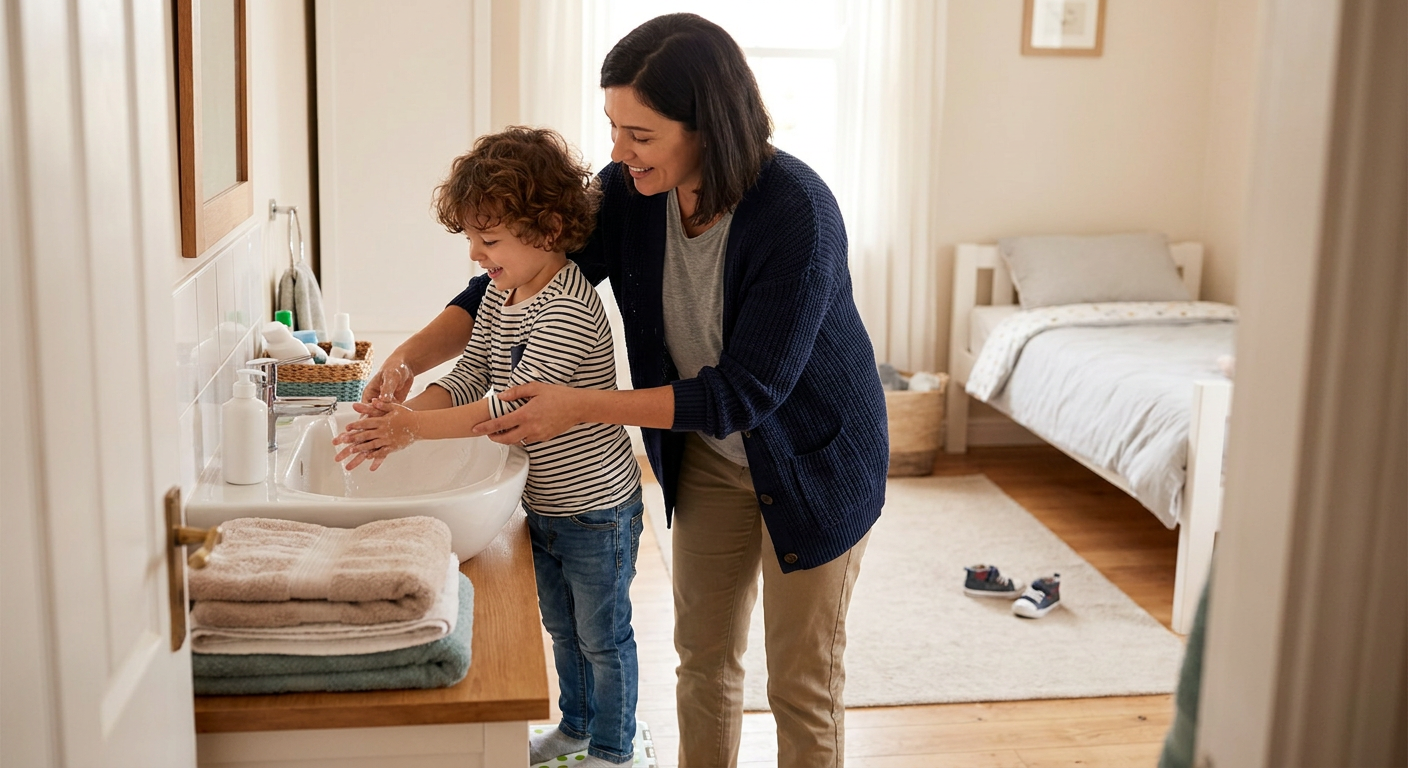
For many Georgia parents, dressing, tooth brushing, handwashing, and bedtime hygiene are not small parts of the day. They are the moments that can turn mornings and evenings into a cycle of stress, repeated prompting, and worry about long-term independence. ABA therapy can help build daily living skills by breaking these routines into teachable steps and helping children practice them in ways that fit real family life.
Daily living skills, self-help skills, and adaptive skills all refer to the routines children use to care for themselves and participate more independently at home, at school, and in the community. This article focuses on how ABA helps children build those skills in dressing, hygiene, and other everyday routines, and how parents can tell when a routine needs more structured support.
Why Dressing, Hygiene, and Daily Living Skills Can Feel So Hard for Some Children
These routines matter for much more than compliance. They affect school readiness, health, privacy, family stress, confidence, and a child’s ability to move through the day with less dependence on adults. When getting dressed or brushing teeth becomes a daily battle, parents often feel frustrated, guilty, and exhausted at the same time.
In many cases, the issue is not that a child “won’t do it.” The routine is breaking down at a specific point. A younger child may tolerate a shirt but resist tags or seams. A school-age child may know each step of handwashing but fall apart when the routine has to happen quickly before school. Another child may understand tooth brushing but become overwhelmed by the taste of toothpaste, the sound of running water, or the transition into the bathroom.
Age matters here. Younger children may need support with basics such as tolerating clothing, washing hands with help, or participating in early tooth-brushing steps. School-age children often need more independence, faster pacing, more privacy, and more consistency across home, school, and community settings.
It is also important to keep clinical guardrails in mind. Pain, significant motor difficulty, dental issues, constipation-related hygiene avoidance, or severe sensory distress may need pediatric, dental, occupational therapy, or other follow-up alongside ABA.
How ABA Teaches Daily Living Skills in Real Routines
ABA does not have to treat dressing and hygiene as one large goal. It can break a routine into smaller parts and teach the next achievable step. That matters because many children do not struggle with the whole routine equally. They struggle with one link in the chain.
Task analysis means identifying each step in a routine, such as getting socks, putting one foot in, pulling them up, then moving to shoes. Chaining helps teach those steps in an order that makes sense for the child. Prompting and fading allow support at the beginning while working toward less help over time. Reinforcement gives the child a reason to stay with a hard task, especially when the routine involves discomfort, delay, or uncertainty. Generalization means the skill should work in real life, not only in a therapy session.
For younger children, that may mean using very small teaching steps, visuals, or hands-on support at first. For school-age children, the focus may shift toward sequencing, pace, and independence under real morning or bedtime pressure. Progress often looks like less resistance to starting, fewer prompts during the routine, more steps completed independently, and success with more than one caregiver or in more than one setting.
If a child can do a routine step in one environment but not another, carryover becomes part of the goal. That is one reason everyday routines often connect to broader independence skills such as school readiness, not just isolated practice.
The Routine Independence Ladder
Breakpoint
The first step is identifying the exact moment the routine breaks down. Instead of saying “getting ready is hard,” it is more useful to ask whether the problem starts when the child has to choose clothes, tolerate a texture, begin tooth brushing, rinse shampoo, or move from one hygiene step to the next. Pinpointing the stuck step gives the team something concrete to teach.
Barrier Lens
Once the stuck step is clear, the next question is why it is hard. The barrier may be sensory discomfort, communication confusion, sequencing overload, motor difficulty, transition stress, or inconsistent expectations across adults. More than one barrier can be active at the same time. If the child shows strong distress around hair washing, for example, ABA may help with routine participation, but OT, pediatric, or dental input may still be appropriate depending on the cause.
Build the Smallest Win
The goal is not instant full independence. It is the next teachable success point. That might be putting on one clothing item without protest, tolerating a toothbrush for a short interval, completing handwashing with fewer prompts, or fastening one part of an outfit independently. Small wins matter because they give the child a clear path forward and give parents a way to measure progress without expecting perfection.
Bridge Across Settings
A skill is more meaningful when it transfers across therapy, home, school mornings, and community routines. Parents and clinicians should watch for situations where the child can complete a step with one caregiver, in one bathroom, or only when there is no time pressure. For school-age children in particular, caregiver-to-caregiver consistency and school-morning carryover can be as important as the original teaching plan. When behavior patterns seem to change by setting or demand, it can help to understand the function behind avoidance or distress more clearly in this guide to behavior functions.
Benchmark the Next Phase
A plan is usually moving in the right direction when prompts are decreasing, distress is easing, success is showing up more consistently, and the child can use the skill in real routines instead of only in one narrow setup. If the same breakdown point is not changing, distress is rising, or parents still cannot carry the skill over after coaching, the plan may need to be adjusted or coordinated with other supports.
Daily Routines ABA Can Target for More Independence
Dressing for the Day
ABA can target clothing tolerance, sequencing, fasteners, shoes, and weather-appropriate dressing. For younger children, the goal may be participating in part of the routine or tolerating specific clothing items. For school-age children, the goals often include less stalling, fewer reminders, and getting dressed more independently under real school-morning time pressure.
Handwashing and Tooth Brushing
These routines often involve more than knowing the steps. A child may struggle with the feeling of wet hands, the taste of toothpaste, the motor planning involved in brushing thoroughly, or the transition into the task itself. ABA can support both partial participation and fuller independence by teaching the next step the child can reasonably handle rather than treating the entire routine as all-or-nothing.
Bathing, Hair Care, and Bedtime Hygiene
Bathing and bedtime hygiene can be especially difficult because fatigue, sensory load, privacy, and multi-step sequencing all tend to converge at the end of the day. ABA may target washing, rinsing, hair brushing, face washing, and smoother movement from one step to the next. If there is pain, scalp or skin irritation, or severe distress, non-ABA follow-up may need to happen alongside skill building.
Related Self-Care Skills Without Going Off-Topic
Some children also struggle with related self-care tasks such as simple grooming, eating routines, and bedtime readiness. Those areas can connect naturally to dressing and hygiene, but they should not replace the main focus of the routine plan. Toileting-related hygiene and puberty-related privacy concerns may overlap, but they usually need their own more targeted guidance rather than being folded fully into a general daily living article.
Common Barriers That Keep Self-Care Routines Stuck
Sensory discomfort can look like refusal to wear certain clothing, panic during hair rinsing, or intense avoidance of toothpaste or water on the face. Transition resistance can look like a child who knows the routine but escalates when asked to start it. Communication gaps may show up when a child does not understand what comes next or cannot express what feels wrong. Fine-motor strain can affect buttons, zippers, toothbrush control, and clothing fasteners. Prompt dependence can make a child appear capable only when one adult walks them through every step. Inconsistent expectations across caregivers can slow progress even when the skill itself is starting to develop.
These patterns are easy to mistake for noncompliance. In reality, they often reflect overload, confusion, discomfort, or a learned dependence on adult prompting. When sensory regulation is part of the picture, some families also benefit from understanding how repetitive coping behaviors or stress responses fit into the routine, as explained in this article on stimming.
ABA can help adjust the routine, the prompt level, the reinforcement plan, and the pace of teaching. But it should not be treated as the only answer for every barrier. Some children need medical, dental, OT, or school coordination as part of the full solution.
How Parents Can Support Carryover at Home Without Doing Therapy Alone
Parents do not need to become the therapist for a child to make progress. What matters most is consistency in everyday routines. That may mean using the same routine language across caregivers, keeping expectations realistic, practicing one targeted step at a time, and noticing what changes the outcome.
For younger children, home support may look like setting up the environment, keeping the sequence simple, and reinforcing participation. For school-age children, it may involve supporting independence while still using structure, especially during school mornings, community outings, or transitions between caregivers. If a family is realizing that routine breakdowns keep showing up outside school support, it may help to look at whether in-home ABA or school-based support is the better fit for the child’s daily life.
The goal is not perfection. It is helping the child use the skill more often, with less stress, in the places where it actually matters.
Daily Living Routine Breakdown Planner
A useful way to prepare for an intake call, BCBA review, or parent-training session is to document the routine in a simple planner. Instead of writing “hygiene is hard,” parents can track:
- The routine
- The exact stuck step
- What the child does now
- The likely barrier
- What support is already being used
- What changed the outcome
- Where the skill works or fails
- Questions for the ABA team
Helpful routines to track include dressing initiation, clothing tolerance, buttons and shoes, handwashing, tooth-brushing tolerance, hair care, bath transitions, bedtime self-care, and school-morning pressure. This kind of planner helps families bring specific examples instead of a general sense that every routine is a struggle.
When Georgia Families Should Seek More Individualized Support
Simple home adjustments may not be enough when the same self-care breakdown keeps repeating, distress is high or escalating, hygiene difficulties are affecting health or school readiness, or the skill is still not transferring across settings despite steady practice. At that point, families may need a more individualized ABA plan, more parent coaching, OT coordination, pediatric or dental follow-up, or school input around morning routines and hygiene barriers.
For Georgia families, access questions can also shape next steps. Medicaid, Katie Beckett, and plan-specific questions through providers such as Peachstate, Amerigroup, Caresource, Anthem/BCBS, or Aetna may all affect how support is pursued. A provider such as Skyward Spectrum can help families think through those daily living challenges with an in-home, family-centered lens, especially for families in Georgia who need support that works in real routines rather than only in theory.
FAQ
What are daily living skills in ABA therapy?
Daily living skills are everyday self-care routines such as dressing, handwashing, tooth brushing, bathing, grooming, and other tasks that support health, participation, and independence. You may also hear them called self-help or adaptive skills.
How does ABA therapy teach dressing and hygiene skills?
ABA teaches these skills by breaking routines into steps, supporting the child at the right level, reinforcing progress, and gradually reducing help over time. The focus is usually on the exact stuck step rather than expecting the whole routine to improve at once.
At what age should daily living skills support start?
Support can start whenever a child is showing a need. Younger children may work on participation and tolerance, while school-age children may work on speed, sequencing, privacy, and greater independence. There is not one single age when support should begin.
How long does it take to build daily living skills through ABA therapy?
Progress is usually gradual, not immediate. The timeline depends on the child’s barrier, how consistently the routine is practiced, and whether the skill carries over across settings and caregivers. It is better to look for steady movement than a fixed deadline.
Are daily living skills taught at home, in clinic, or both?
They can be taught in either setting, but these routines often improve best when practice connects to the place where they actually happen. Many children need support in more than one setting so the skill can carry over into real daily life.
How does ABA help with sensory challenges that affect dressing or hygiene?
ABA can help identify patterns, reduce overload, build tolerance gradually, and teach participation step by step. At the same time, sensory-related challenges may also need OT or other clinical support, depending on what is driving the difficulty.


