


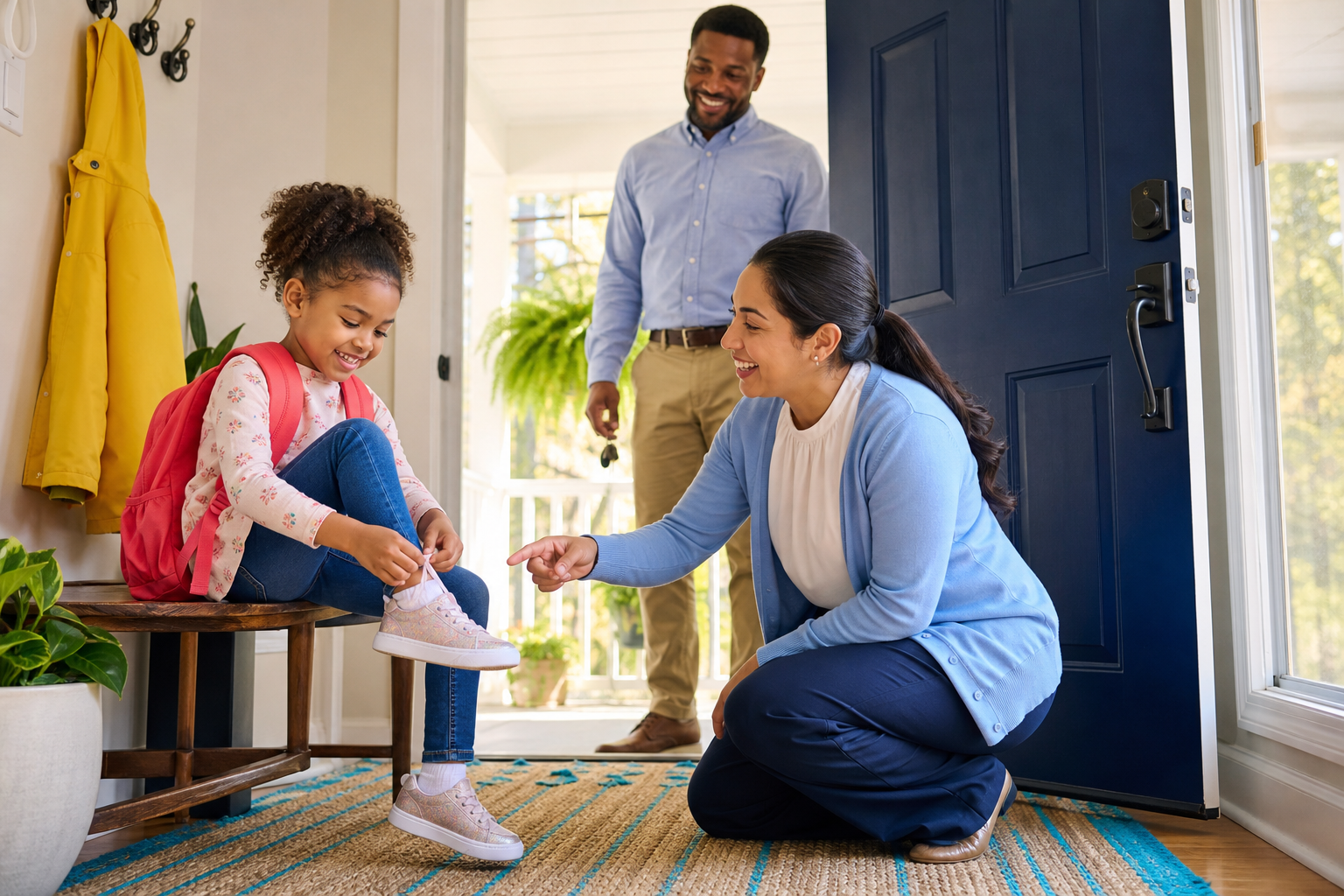
At the therapy table, your child asks for “help” like a pro. Then 7:40 a.m. rolls around on a school day, a shoe won’t go on, and the word disappears. Instead there’s crying, a thrown sneaker, and a very late carpool.
That gap between “can do it in therapy” and “does it in real life” has a name: generalization. It’s also one of the biggest reasons families choose in-home ABA therapy in Georgia.
In this article, we’ll explain what skill generalization means and why practicing at home helps skills stick. Then we’ll show what that looks like in an ordinary Georgia family’s week. We’ll also cover how your BCBA checks whether a skill has truly taken hold.
What Is Skill Generalization in Autism, and Why Does It Matter?
Generalization means using a skill beyond the place and person who taught it. A child who learns to say “help” with their therapist should also say it with Grandma. They should use it at the kitchen table, at the park, and with a jar lid as well as a shoe. And the skill should still be there weeks later, which is often called maintenance.
Without generalization, a skill only lives in therapy. It looks great on a progress report but doesn’t change much about your evenings. That’s frustrating for everyone, especially your child.
This isn’t a small concern. In the US, about 1 in 31 children aged eight has been identified with autism, according to the CDC. That’s a lot of Georgia families who need skills that work in real homes, not just in clinics.
Think of it like learning to drive. Practicing in an empty parking lot builds the basics. But at some point, you need to drive on your own street, with real traffic and your own kids in the back seat. Home-based ABA brings practice onto your street from day one.
Why Does In-Home ABA Help Skills Generalize?
The biggest reason is simple. Home is where your child needs the skills most. When therapy happens in your living room, kitchen and backyard, every lesson is already in the right setting.
In-home ABA often uses natural environment teaching. Instead of only working at a table with flashcards, the RBT teaches during real routines. Asking for a snack happens at snack time.
Taking turns happens with an actual sibling and an actual toy. The rewards are natural, too, like getting the snack or the next turn.
Real people and real triggers are part of practice from the start. The barking dog, the loud TV, the little brother who grabs everything. Your child learns to use new skills with all of that going on, not in a quiet room that looks nothing like home.
Parent coaching is the other big piece. When you learn the same prompts and praise the therapist uses, practice keeps going between sessions. A skill your child uses at 6 p.m. with you, and at 10 a.m. with the RBT, is far more likely to stick.
The research supports this mix. Naturalistic intervention and parent-implemented intervention both appear in the 2020 evidence-based practices review (PDF). That review looked at nearly a thousand studies.
To be fair, center-based programs have real strengths. They can offer more chances to practice with peers and a structured setting that some children enjoy. Plenty of families use a mix. But if your top goal is skills that hold up at home, in-home ABA therapy gives those skills a head start.
What Does Generalization Look Like in Everyday Georgia Home Routines?
Generalization isn’t abstract. It shows up in the most ordinary moments of your day. Here’s how it might look across one week, starting with the hardest stretch for many families.
The school-morning rush
Mornings are a great place to start, because they’re packed with skills: getting dressed, eating breakfast, finding shoes and getting out the door. Your BCBA might pick one target, like asking for help with tricky clothing. The RBT practices it during a morning session, using the real shoes, the real backpack and the real front door.
Then you take over. You use the same words, like “Say, help please,” and the same quick praise. At first you may prompt every time.
Over a few weeks, you prompt less, and one morning your child just says it. No tears, no thrown sneaker, no late carpool. That’s generalization in action.
The team doesn’t stop there. Next, they might check whether your child asks for help with a jacket zipper at Grandma’s house, or a stuck lunchbox at school. Each new setting makes the skill stronger.
Other routines worth practicing
Mealtimes are perfect for requesting, waiting and trying a new food at Sunday dinner with extended family. Afternoons indoors, especially during a hot, sticky Georgia summer, are great for turn-taking with a sibling over a board game.
Bedtime matters, too. A calm, predictable routine helps your child wind down and teaches steps like brushing teeth and choosing pajamas. It also protects sleep, and the AAP explains how much sleep children need by age. A well-rested child is usually more ready to learn the next day.
Which Skills Benefit Most From Practice at Home?
Almost any skill can be practiced at home, but some really shine there. Daily living skills are the obvious ones. Brushing teeth, washing hands, getting dressed and helping set the table all happen at home anyway, so practicing them anywhere else adds an extra step.
Communication skills are close behind. Requests, greetings and “all done” come up dozens of times a day in a busy household. Each one is a natural chance to practice, with a real reward attached.
Behavior goals benefit, too. If the hardest moments happen at bath time or when screens turn off, those are the moments your team needs to see. An RBT in your living room can catch the early signs and teach a better option right then.
Sibling play is another big one. Sharing, waiting and taking turns are much easier to teach with the actual brother or sister your child lives with. And yes, the siblings often enjoy the extra attention.
How Does the BCBA Know a Skill Has Generalized?
Your BCBA doesn’t guess. They test. One common method is a probe, which means checking a skill in a new situation without prompting.
For example, after weeks of practicing “help” with the RBT, the BCBA might set up a tricky container with you, not the therapist. If your child asks for help on their own, that’s strong evidence the skill has generalized to a new person. Later, they might check again with a different object or in a different room.
Maintenance checks come next. A few weeks after a goal is met, the team circles back. Is the skill still there? If yes, great. If it’s slipping, they add a little practice before moving on.
When skills hold across people, places and time, your child’s plan moves forward. New goals get added and support can gradually fade. That’s the point of good ABA. Here’s more on how therapy fades as skills hold.
What Can Parents Do to Help Skills Stick?
You’re the secret ingredient here, and it doesn’t take hours a day. Ask your BCBA which one or two routines matter most right now, and focus there.
Use the same words the therapist uses. If the RBT says “First shoes, then car,” you say it too. Consistency helps your child recognize the skill no matter who’s asking.
Watch for skills showing up on their own, and react right away. A quick “You asked for help, awesome!” tells your child they did the right thing in a brand-new moment.
And share what you see. A short note or video of your child using a skill at the grocery store helps your BCBA update the plan. So does a quick story from a cousin’s birthday party.
Where Is In-Home ABA Available in Georgia?
Skyward Spectrum brings ABA into family homes across the state. We serve Metro Atlanta, the Augusta area, Macon and Warner Robins, and Coastal Georgia, including Savannah. Take a look at the areas we serve in Georgia to find your county.
Our BCBAs build plans around your family’s real routines, and our RBTs make sessions feel more like fun than work. Want skills that can fly solo, at home and beyond? Book a free consultation and let’s talk about your child’s goals.
FAQ: In-Home ABA and Skill Generalization
Is in-home ABA better than center-based ABA?
Neither is best for every child. In-home ABA makes it easier to practice skills in real routines with family. Centers can offer more peer interaction. Many families use a mix.
How do I help my child use skills outside therapy?
Ask your BCBA which routines to practice and use the same words the therapist uses. Then praise the skill whenever it shows up on its own.
Does Georgia Medicaid cover in-home ABA?
Georgia Medicaid covers medically necessary ABA for members under 21 with prior authorization. Our team can help you check your benefits.


