


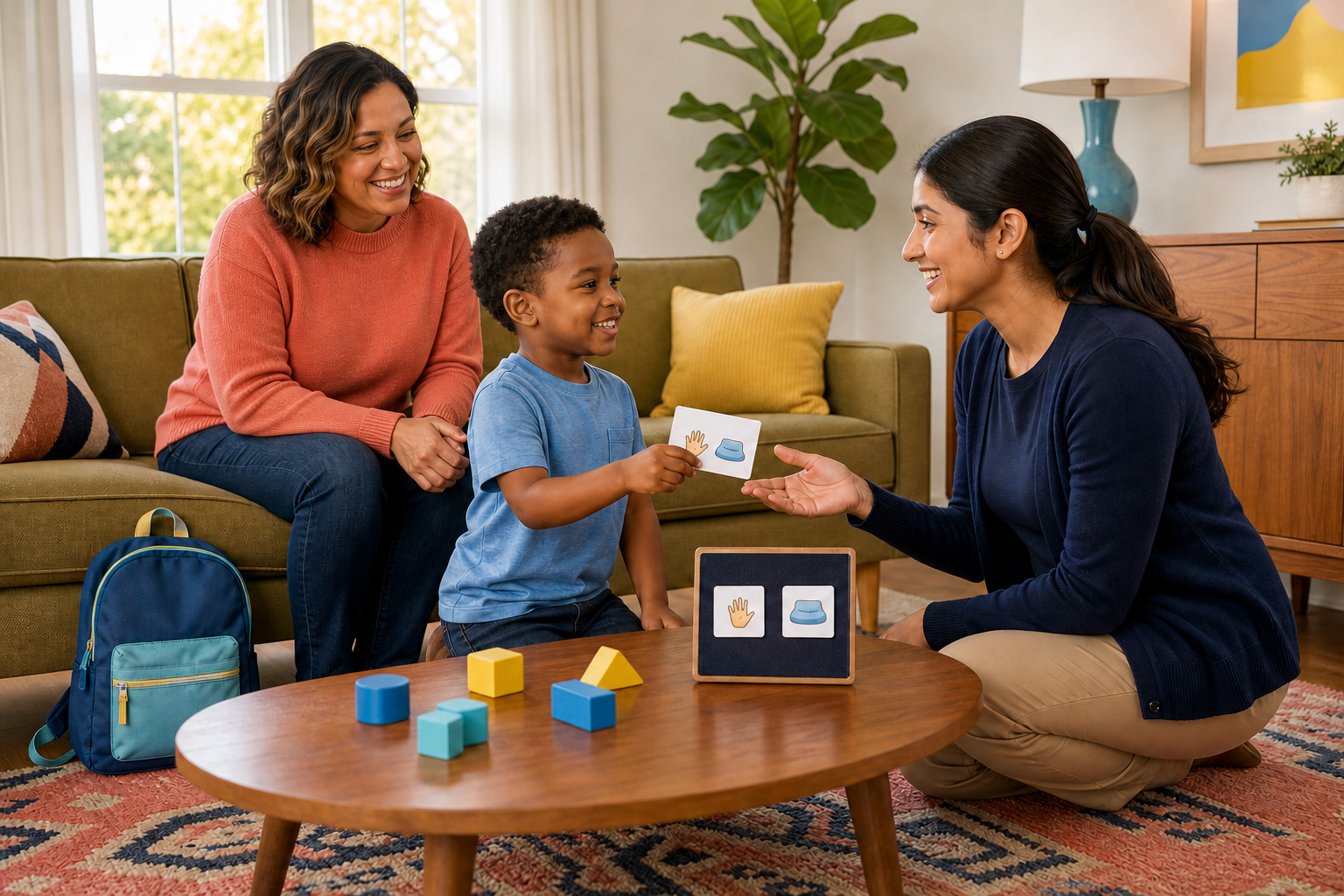
Your child’s IEP says they’ll “request a break using a break card.” At home, the RBT has been teaching them to say “break, please” out loud. Both goals make sense. But your child is getting two different messages about the same skill, and on a hard Tuesday, that confusion shows.
Wondering how school based ABA therapy in Georgia fits with what happens at home? The answer usually starts with getting everyone on the same page.
This guide explains how IEPs and in-home ABA work together and how to line up goals. We’ll also cover whether an RBT can support your child in a Georgia classroom, and how to bring your BCBA into the IEP conversation. Same flight plan, two cockpits.
How Do IEPs and In-Home ABA Fit Together in Georgia?
Let’s start with the basics, because the two systems run on different tracks. Under IDEA, the federal special education law, eligible children receive a free appropriate public education. Part B of IDEA covers children ages 3 through 21, and the IEP is the school’s legal plan for delivering that education.
In-home ABA is different. It’s a behavioral health service, usually funded by private insurance or Georgia Medicaid. It’s based on medical necessity, not educational eligibility, and it follows a treatment plan written by a BCBA.
That means ABA doesn’t replace an IEP, and an IEP doesn’t replace ABA. They’re separate plans with separate rules. Still, they’re working with the same child, and that’s the key.
Want to know how special education works in this state, including dispute options? The Georgia Department of Education explains Georgia’s special education parent rights in detail.
How Do You Align ABA Therapy and IEP Objectives?
This is the heart of it. When school and home teach the same skill the same way, your child gets twice the practice and half the confusion. Here’s how families and teams usually make that happen.
Start by sharing plans. With your written permission, share the IEP with your child’s BCBA, and share the ABA treatment goals with the IEP team. Most providers and schools will ask you to sign a release of information first, which is normal and protects your child’s privacy.
Next, pick a few shared targets. Two to four is plenty. Good candidates are skills that matter in both places, like asking for help, handling transitions or following group directions. Trying to align everything at once usually means nothing gets aligned well.
Then agree on the details. Same words, same visuals, same prompts. If school uses a break card, home can use the same card. If the teacher says “first work, then choice,” the RBT says it too.
It also helps to name a point person on each side. Maybe it’s the special education teacher at school and the BCBA at home. When questions come up, everyone knows who to call, and nothing falls through the cracks.
Finally, share data. IEP goals have to be measurable, so the school is already tracking progress. That’s part of what an IEP has to contain. A quick monthly swap of notes or graphs lets both teams see what’s working and adjust.
Here’s what a simple alignment chart might look like. It’s an example, so your child’s version will look different.
| IEP goal | Home ABA target | Shared cue | Who tracks |
| Requests a break during work tasks | Requests a break during homework and chores | Same break card at school and home | Teacher and RBT |
| Moves between activities with a visual schedule | Moves from screen time to dinner with a visual schedule | “First, then” board | Para and parent |
| Follows two-step group directions | Follows two-step directions during routines | Same wording for directions | Teacher and BCBA |
Even one aligned goal can make a real difference. Your child stops having to guess which rules apply where. For more on how we approach goal-setting, here’s an overview of our ABA services.
How Can Home Practice Support School Goals?
In-home sessions are a great place to rehearse school skills before your child needs them in a busy classroom. Think of it as a dress rehearsal with a friendly audience.
Say the IEP includes raising a hand before talking during group time. At home, the RBT might set up a short “circle time” at the coffee table with a sibling or parent. Your child practices waiting, raising a hand and taking a turn, then earns something they enjoy. When the real circle time comes at school, the routine already feels familiar.
Homework is another natural bridge. If your child struggles to start tasks, the team can practice the same first steps the teacher uses. Same timer, same “first, then” board, same break card.
Mornings matter, too. A calm, predictable start at home can set up a better day at school. Some families work on packing a backpack or following a morning picture schedule, so their child arrives ready instead of rattled.
Can an RBT Support Your Child in a Georgia Classroom?
This is one of the most common questions we hear, and the honest answer is: it depends on the district. Each Georgia school district sets its own rules about outside providers on campus.
Some districts employ their own behavior staff, including RBTs, to support students in classrooms.
Others allow private providers in certain situations, usually after an approval process. That process often includes background checks, a written agreement and a clear plan for what the RBT will and won’t do.
Observations are often easier to arrange than ongoing classroom support. A BCBA watching your child in class for an hour can learn a lot about triggers and routines. Ask the school whether a scheduled observation is possible.
Funding is another question. Some insurance plans don’t cover ABA delivered at school, because school services are the district’s responsibility under IDEA. Check with your plan before assuming coverage.
And if an RBT can’t come into the classroom? Collaboration still works. Shared goals, shared cues and regular updates can do a lot, even when home and school staff never stand in the same room.
Can You Bring Your BCBA to an IEP Meeting?
Yes, in most cases. Under IDEA, parents can invite people who have knowledge or special expertise about their child to IEP meetings. Your child’s BCBA can be one of those people.
Let the school know ahead of time who’s coming and what they’ll speak to. A short summary from your BCBA, like what’s working at home and which skills might help at school, can make the meeting more productive.
Keep the tone collaborative. Teachers and IEP teams want your child to succeed, too. The BCBA’s role is to add information, not to take over the meeting.
Sometimes families and schools don’t agree. That’s okay, and you have options. IDEA gives parents your procedural safeguards, including mediation and due process. For free, one-on-one help, Parent to Parent of Georgia supports families with IEP questions and rights.
What Should You Bring to an IEP Meeting?
A little prep goes a long way. Bring a copy of the current IEP with your notes in the margins, plus any recent progress reports from home therapy. If your BCBA can’t attend, ask them for a one-page summary you can share.
Write down your top two or three priorities. IEP meetings can move fast, and having your list in hand keeps the most important topics on the table.
Bring examples, too. A short video of your child using a new skill at home can say more than a page of notes. Teachers often love seeing what their students can do outside school.
And ask questions. “How will this goal be measured?” and “How will you let me know how it’s going?” are both fair game.
Ready to Get School and Home Working Together?
At Skyward Spectrum, our BCBAs coordinate with teachers and IEP teams whenever families want us to. We help you share goals, line up cues and keep everyone looking at the same data. It’s the same flight plan in two cockpits, and your child gets a smoother ride.
We provide in-home ABA across Georgia, from Metro Atlanta and Augusta to Macon and the coast. If you’d like help connecting the dots between your child’s IEP and home therapy, talk with our team.
FAQ: IEPs and In-Home ABA in Georgia
Does ABA therapy replace an IEP?
No. An IEP is the school’s legal plan under IDEA. ABA is a separate service, usually funded by insurance or Medicaid. Goals can still be aligned so your child practices the same skills in both places.
Can Georgia schools refuse a private RBT in the classroom?
Yes. Districts set their own rules for outside providers. Ask the IEP team or the district special education office what’s allowed and how to request it.
How often should home and school share data?
Monthly works for many families, plus a quick update after any big change at home or school. A shared notebook or email thread keeps it simple.


