


If you have been worrying about autism social skills development, you are not alone. Many parents watch their child play alone, struggle through a playdate, or stay on the edge of a group and wonder whether real connection will ever come. That fear is understandable, especially when other children seem to move into friendships more easily.
The short answer is that many children with autism can build meaningful social connection, but it may not look the way parents expect at first. Progress is often gradual. It may start with sitting near another child, copying part of a game, accepting a short turn, or returning to the same peer again and again before it looks like friendship in the usual sense.
This article is here to help you think clearly about what progress can look like, what kind of support fits your child right now, and when extra help may make sense. The goal is not to promise a timeline. It is to give you a calmer, more useful way to understand what your child may be ready for next.
Why Playing With Others Can Be Harder for Children With Autism
Playing with other children is not one single skill. It depends on regulation, communication, play style, peer fit, and the environment. A child may want connection and still have trouble joining in if the setting is noisy, the game changes too quickly, or the social demand is too high.
Common barriers can include sensory overload, hard transitions, waiting and turn-taking demands, communication differences, rigid ideas about how toys should be used, or stress in unstructured places like recess and birthday parties. Difficulty in these settings does not automatically mean a child is uninterested in other people. Often, it means the situation is asking for skills that are not fully in place yet.
For younger children, the important foundations may be shared attention, imitation, staying near another child, and short back-and-forth play. For school-age children, the challenge often shifts toward managing group expectations, reading peer behavior, handling recess, and tolerating the unpredictability of playdates.
Guidance from the Eunice Kennedy Shriver National Institute of Child Health and Human Development supports the idea that social skills can be taught and practiced in structured ways. That matters because it reminds parents that social growth is not simply something a child either has or does not have.
What Social Progress Can Realistically Look Like Over Time
Social progress is often non-linear. A child may do well with one familiar peer and struggle the next day in a loud setting. That does not erase progress. It usually means the demands were different.
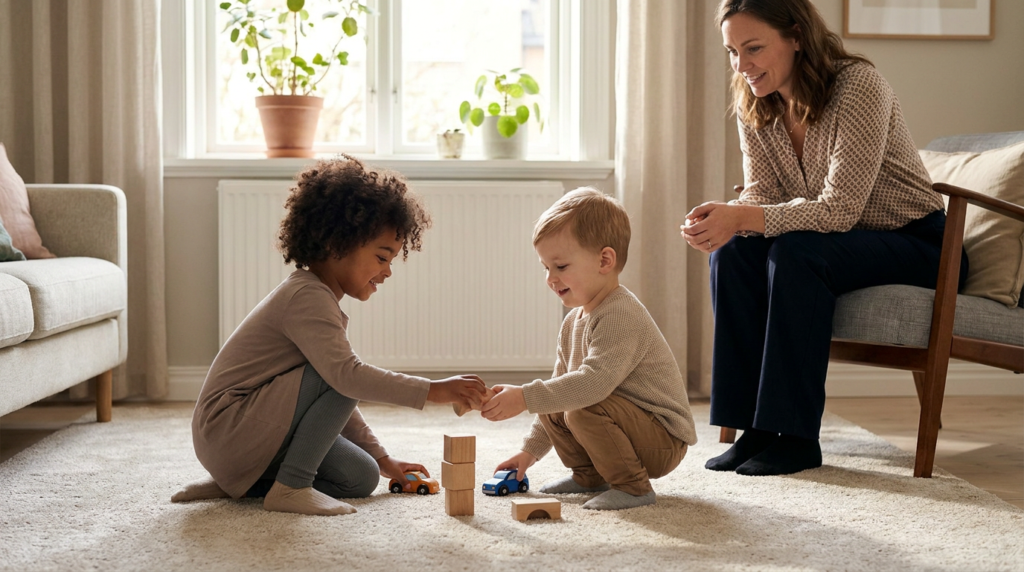
It can help to think about social play as a progression. Many children begin with comfortable solo play. Then they may tolerate being near another child. From there, they may move into parallel play, where both children are engaged in the same space without truly sharing the activity. Later, you may see short moments of shared interest, turn-taking, brief cooperative play, and eventually early friendship preferences.
What counts as progress in real family life? Staying near peers longer. Accepting a simple turn. Joining a familiar game for a few minutes. Commenting during play. Looking toward another child when something funny happens. Recovering more quickly after social stress. These are meaningful signs that the foundation is growing.
For preschoolers, readiness may look like imitation, shared materials, and short playful exchanges. For school-age children, it may look like choosing one peer, handling simple group rules, or getting through a short playdate with support. Resources like Raising Children Network are helpful because they frame play as a developmental process rather than an all-or-nothing milestone.
Bridge-to-Belonging Map
1) Starting Point Lens
Start by identifying your child’s current interaction pattern. Are they most comfortable playing alone? Can they stay near another child? Do they tolerate parallel play, share brief exchanges, or enter shared play for short stretches?
This matters because parents often measure everything against the end goal of friendship. A better question is: what can my child do right now with support? A child building alone while another child builds nearby may already be working on a meaningful early stage of connection.
2) Regulation Fit Lens
Look at what makes social moments easier or harder. Noise, waiting, transitions, language load, sensory demands, and unpredictability can all change how much social energy a child has available.
Sometimes the right next step is not more peer exposure. It is a quieter room, a shorter activity, clearer expectations, or a more predictable routine. When the environment fits better, social ability often becomes easier to see.
3) Interest Bridge Lens
Many children with autism connect best through what already matters to them. Preferred toys, favorite characters, movement games, trains, building activities, or sensory play can all become a bridge into back-and-forth interaction.
Instead of forcing generic social games, start with what already draws your child in. If your child loves ramps and cars, another child can send cars down the same track. If your child loves bubbles, take turns popping or requesting more. Shared interest usually creates less pressure than small talk or open-ended free play.
4) Peer & Setting Match Lens
The setup matters. A familiar peer may work better than an unfamiliar one. One-on-one practice may be easier than a small group. A structured activity may succeed where free play fails. Home may work better than a busy playground.
The wrong setting can make a child look unready when the real issue is mismatch. School-age children often show this clearly: they may do well with one child during a planned activity but fall apart during chaotic recess or a noisy birthday party.
5) Support Fade Lens
Adults often need to help at first, but the goal is not to run the whole interaction. Helpful support might look like modeling one short phrase, setting up one turn-taking activity, or stepping in briefly after a social misstep. Too much support looks like constant talking, over-directing, or preventing the children from finding their own rhythm.
Try fading from full scripting to short prompts, from adult-led game setup to child choice, and from staying right beside the children to checking in from a short distance. Small steps back often give children more room to use the skills they are building.
Practical Ways to Help Your Child Build Real Social Connection
Use interests to create low-pressure interaction
Choose activities your child already enjoys instead of starting with a purely social goal. Shared interest is often the easiest route into social practice. You can build simple back-and-forth into blocks, trains, movement games, art, water play, or favorite themes.
If the interaction stalls, simplify. Shorten the activity. Reduce the number of turns. Lower the language demand. A smaller, easier success is more useful than pushing through a longer, stressful attempt.
Set up the right kind of play practice
Think one peer, one activity, one setting, and one short duration. Pick a child who is flexible and not overly controlling. Prepare materials ahead of time. Choose a clear activity with a beginning and an end.
Avoid making a large unstructured group your first test. A child who cannot manage a loud group is not necessarily failing socially. The step may simply be too big right now.
Coach the moment without taking over
Model simple play language such as “my turn,” “your turn,” “let’s build,” or “want more?” Use brief verbal or visual prompts only when needed. If one child grabs a toy, help repair the moment with a short prompt and then step back again.
The goal is to support shared attention, turn-taking, and recovery from minor social mistakes without turning the interaction into an adult-led lesson.
Apply the approach in real-life settings
At home, use familiar toys and predictable routines. A sibling or one familiar peer can work well when the activity is clear and the adult support is calm.
At the playground or school, look for short supported entry points rather than expecting long free play. Joining a chase game for two minutes, taking one turn on an activity, or playing beside one peer may be a better goal than “go make friends.”
For playdates or community outings, prepare the activity, keep the visit short, have a simple exit plan, and watch for signs your child is getting overloaded. Ending a visit while it is still going reasonably well often sets up the next one more successfully.
Decision Tool: What Kind of Social Practice Fits My Child Right Now?
Start with your child’s current play stage. If your child mainly plays alone but can tolerate another child nearby, begin with supported parallel play. If your child can handle proximity and short exchanges, try a brief turn-taking activity. If your child can share interest with one familiar peer, a short interest-based playdate may fit.
Then check the setting. How much noise, unpredictability, and waiting does it involve? What communication support does your child need? Is the other child familiar? Is the activity structured enough? How long can your child realistically stay regulated?
From there, choose the next step that matches the situation: supported parallel play, short turn-taking, an interest-based one-peer playdate, coached playground practice, or small structured group exposure. If most settings lead to distress or breakdown even after simplifying the fit, that is a sign to talk with a clinician about more intensive support.
When Extra Support May Help
Extra support may be useful when social situations are repeatedly distressing, when communication or regulation needs consistently outpace the setup, when better-matched practice still does not lead to progress, or when school and community settings break down more often than they succeed.
That support might include parent coaching, ABA, speech support, occupational therapy, or a social skills group. The right option depends on what is getting in the way. Some children need help with communication access. Others need support with flexibility, regulation, or structured peer practice.
At Skyward Spectrum, these questions are often approached with the understanding that social growth is built over time through supportive teaching, realistic expectations, and practice in everyday settings. The goal is not to force connection. It is to make connection more possible.
FAQ
Do children with autism interact with others?
Yes, children with autism can interact with others, but the form that interaction takes may look different at different stages. Some children start with proximity, shared attention, or repeated interest in the same peer before they show more obvious friendship behaviors.
How can I help my child develop social skills?
Start with interest-based play, a good peer match, a predictable setup, and brief adult support that fades over time. The best plan usually focuses on the next manageable step rather than a high-pressure social goal.
Should I encourage my child to play with other kids?
Yes, but encouragement should be supportive, not overwhelming. Low-pressure practice in the right environment is usually more helpful than pushing a child into a setting that is too loud, too long, or too socially complex.
What are effective strategies for teaching play skills to children with autism?
Effective strategies often include modeling, short turn-taking routines, clear activity setup, visual or verbal prompts, repetition across familiar settings, and matching the task to the child’s current play stage.
What role do social skills groups play in autism therapy?
Social skills groups can help when a child is ready to practice with peers in a structured setting. If group demands are still too high, one-on-one or very small-scale practice may be a better first step.
At what age should social skills support begin?
Support can begin early, but the goal should match the child’s developmental stage. For younger children, that may mean shared attention and simple back-and-forth play. For older children, it may mean handling recess, short playdates, or early friendship skills.


